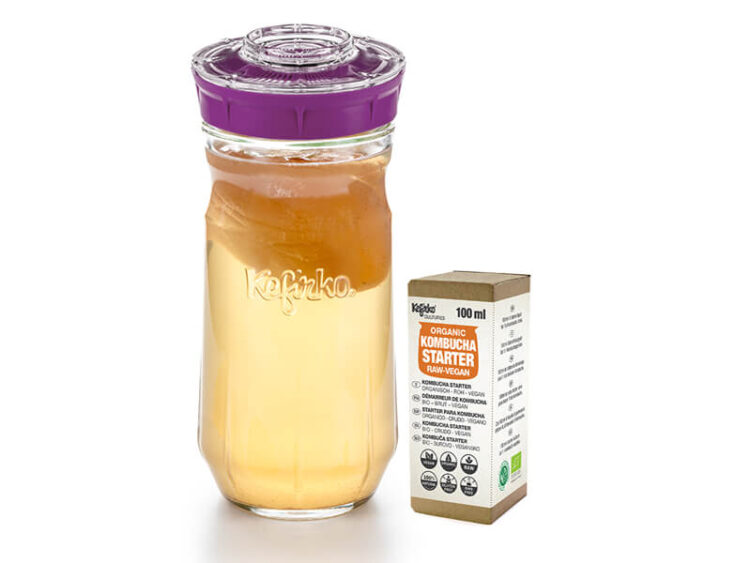
Kombucha, a fermented tea drink with a history stretching back thousands of years, has acquired its own set of myths and misunderstandings over time. Here we will talk about some of them.
Kombucha is a very popular fermented drink known because of its many qualities. It has antioxidants that fight harmful free radicals, supports natural detoxification, and promotes a healthy gut with its beneficial bacteria. What’s more, it’s easy to make at home, allowing you to experiment with flavours and fermentation times while enjoying the many potential health benefits.
Myths that we often hear when we talk about kombucha:
This is not a myth.
1. Kombucha is an invigorating beverage
Many people find kombucha to be invigorating due to its refreshing and effervescent qualities. However, this invigoration is not primarily connected to the caffeine content in tea. It’s more related to the overall combination of the drink’s flavour, natural carbonation, and potential for mild stimulation from its caffeine content. Kombucha’s invigorating effects are typically milder than those of a cup of coffee, but some individuals do feel a sense of increased energy or alertness after consuming it.
This is not a myth.
2. Kombucha is the perfect source of probiotics
The idea that kombucha is the “perfect” source of probiotics in comparison to all other fermented foods is a matter of debate. While kombucha does contain probiotics and has potential health benefits, it’s not necessarily superior to all other fermented foods in terms of probiotic content or overall health benefits. The choice of the best source of probiotics depends on individual preferences and health goals, and there are many other fermented foods that are also excellent sources of probiotics.
Kefir, for example, is often considered a more reliable source of probiotics as it contains specific strains of beneficial bacteria known to support gut health.
This is a myth.
3. Kombucha has high levels of sugar
The sugar that you use for making kombucha is used up during the fermentation process. When fermentation is completed there is very little sugar left in it, about 2,5g in 250ml. In comparison, the same amount of cola contains about 30g of sugar.
Store-bought kombucha can vary in terms of sugar content and additives though, depending on the brand and specific product. Some store-bought kombuchas may have added sugars or artificial flavourings, while others prioritize natural ingredients and lower sugar content. It’s important to read the labels and ingredient lists to make an informed choice. Homemade kombucha allows for more control over the ingredients and fermentation process, making it a good option for those who want to limit sugar and additives.
Don’t miss out on the new content about fermenting!
Subscribe to Kefirko newsletter
This is a myth.
4. Kombucha has high levels of alcohol
Kombucha is a fermented beverage, and during the fermentation process, trace amounts of alcohol can be produced. However, commercially produced kombucha is generally required to have an alcohol content below 0.5% alcohol by volume (ABV) to be considered non-alcoholic.
Many alcoholic beverages like beer, wine, and spirits have much higher alcohol content, typically ranging from 3% ABV for light beers to 40% ABV or more for spirits. So, while kombucha does contain alcohol, it’s usually in very low concentrations and is not enough to cause intoxication. However, it’s essential to be aware of the alcohol content, especially for individuals who need to avoid alcohol completely for health or personal reasons.
The alcohol content in homemade kombucha can vary depending on several factors, including the fermentation time, temperature, and yeast activity. If the fermentation process is allowed to continue for an extended period or if the conditions are favourable for yeast to thrive, the alcohol content in homemade kombucha may rise slightly above the typical commercial threshold of 0.5%. You can measure the level of alcohol with a refractometer.
To wrap it up, when it comes to kombucha, there’s a mix of facts and myths. Some things people believe about this fermented tea are true, while others are not. Kombucha has a long history and can be good for you, adding a unique and tasty choice to your drinks. So enjoy fermenting it at home.
Lorem Ipsum is simply dummy text of the printing and typesetting industry. Lorem Ipsum has been the industry's standard dummy text ever since the 1500s, when an unknown printer took a galley of type and scrambled it to make a type specimen book. It has survived not only five centuries, but also the leap into electronic typesetting, remaining essentially unchanged. It was popularised in the 1960s with the release of Letraset sheets containing Lorem Ipsum passages, and more recently with desktop publishing software like Aldus PageMaker including versions of Lorem Ipsum.
We use cookies on our website to give you the most relevant experience by remembering your preferences and repeat visits. By clicking “Accept All”, you consent to the use of ALL the cookies. However, you may visit "Cookie Settings" to provide a controlled consent.
This website uses cookies to improve your experience while you navigate through the website. Out of these, the cookies that are categorized as necessary are stored on your browser as they are essential for the working of basic functionalities of the website. We also use third-party cookies that help us analyze and understand how you use this website. These cookies will be stored in your browser only with your consent. You also have the option to opt-out of these cookies. But opting out of some of these cookies may affect your browsing experience.
Necessary cookies are absolutely essential for the website to function properly. These cookies ensure basic functionalities and security features of the website, anonymously.
Cookie
Duration
Description
cookielawinfo-checkbox-advertisement
1 year
Set by the GDPR Cookie Consent plugin, this cookie is used to record the user consent for the cookies in the "Advertisement" category .
cookielawinfo-checkbox-analytics
11 months
This cookie is set by GDPR Cookie Consent plugin. The cookie is used to store the user consent for the cookies in the category "Analytics".
cookielawinfo-checkbox-functional
11 months
The cookie is set by GDPR cookie consent to record the user consent for the cookies in the category "Functional".
cookielawinfo-checkbox-necessary
11 months
This cookie is set by GDPR Cookie Consent plugin. The cookies is used to store the user consent for the cookies in the category "Necessary".
cookielawinfo-checkbox-others
11 months
This cookie is set by GDPR Cookie Consent plugin. The cookie is used to store the user consent for the cookies in the category "Other.
cookielawinfo-checkbox-performance
11 months
This cookie is set by GDPR Cookie Consent plugin. The cookie is used to store the user consent for the cookies in the category "Performance".
CookieLawInfoConsent
1 year
Records the default button state of the corresponding category & the status of CCPA. It works only in coordination with the primary cookie.
viewed_cookie_policy
11 months
The cookie is set by the GDPR Cookie Consent plugin and is used to store whether or not user has consented to the use of cookies. It does not store any personal data.
Functional cookies help to perform certain functionalities like sharing the content of the website on social media platforms, collect feedbacks, and other third-party features.
Cookie
Duration
Description
mailchimp_landing_site
1 month
The cookie is set by MailChimp to record which page the user first visited.
Performance cookies are used to understand and analyze the key performance indexes of the website which helps in delivering a better user experience for the visitors.
Analytical cookies are used to understand how visitors interact with the website. These cookies help provide information on metrics the number of visitors, bounce rate, traffic source, etc.
Advertisement cookies are used to provide visitors with relevant ads and marketing campaigns. These cookies track visitors across websites and collect information to provide customized ads.
Other uncategorized cookies are those that are being analyzed and have not been classified into a category as yet.
Cookie
Duration
Description
cookies.js
session
No description available.
wp-wpml_current_language
session
No description available.
Manage Consent
To provide the best experiences, we use technologies like cookies to store and/or access device information. Consenting to these technologies will allow us to process data such as browsing behavior or unique IDs on this site. Not consenting or withdrawing consent, may adversely affect certain features and functions.
Functional
Always active
The technical storage or access is strictly necessary for the legitimate purpose of enabling the use of a specific service explicitly requested by the subscriber or user, or for the sole purpose of carrying out the transmission of a communication over an electronic communications network.
Preferences
The technical storage or access is necessary for the legitimate purpose of storing preferences that are not requested by the subscriber or user.
Statistics
The technical storage or access that is used exclusively for statistical purposes.The technical storage or access that is used exclusively for anonymous statistical purposes. Without a subpoena, voluntary compliance on the part of your Internet Service Provider, or additional records from a third party, information stored or retrieved for this purpose alone cannot usually be used to identify you.
Marketing
The technical storage or access is required to create user profiles to send advertising, or to track the user on a website or across several websites for similar marketing purposes.